California's SB 343 Just Got Complicated. Here's What Food Packaging Manufacturers Need to Know
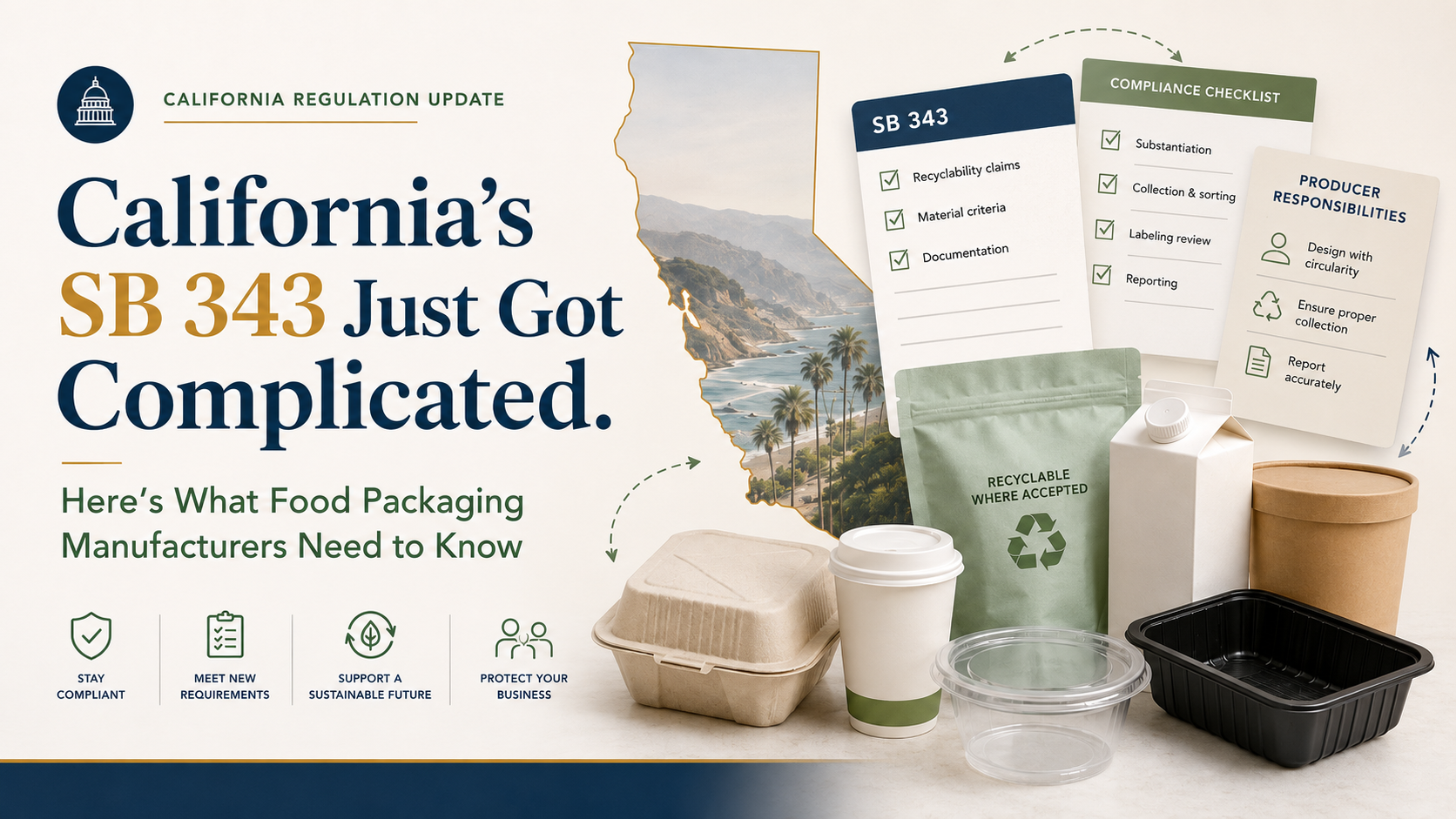
California’s recycling-label rules are changing—and for food packaging manufacturers, compliance now starts long before the label goes on.
A federal court has paused enforcement of California's "Truth in Recycling" law weeks before its October 4, 2026, deadline. The law wasn't eliminated, and the smart move isn't to stop planning.
For nearly a year, brands and packaging manufacturers have been racing toward a single date: October 4, 2026. That's when California's Senate Bill 343 was set to fundamentally change what you can print on a package sold in the nation's largest consumer market.
Then, on July 14, 2026, a federal judge hit pause.
If you make food products, package them, or supply the film and bags that carry them, the situation now demands more nuance than a headline can carry. Here's the clear version.
What SB 343 Actually Requires
Signed in 2021, SB 343 restricts when a product or package may be labeled or marketed as recyclable in California, including the familiar chasing-arrows symbol.
The core of the law is a two-part test often called the 60/60 threshold. To carry a recyclability claim, a material must be:
Collected by recycling programs serving at least 60% of California's population, and
Sorted into defined streams by facilities serving at least 60% of the state's recycling programs.
Miss either threshold, and using the chasing arrows is treated as deceptive or misleading under California law, regardless of whether the material is technically recyclable somewhere.
The burden sits squarely on manufacturers. Companies are responsible for determining whether their materials qualify and for maintaining records supporting any claim they make.
Critically, the restriction attaches to when packaging is manufactured, not when it's sold. Packaging produced before the compliance date could continue moving through the supply chain with existing labels. Any product produced after it would need to comply.
How We Got Here and Where the Clock Stands
April 4, 2025 — CalRecycle published the SB 343 Final Findings Report, the material characterization study that establishes which material types and forms actually meet the statutory criteria. This document is the baseline for every recyclability determination under the law.
Statutory 18-month clock—Publication of that report started an 18-month compliance runway, setting the labeling restrictions to take effect October 4, 2026.
March 2026 — A coalition of industry associations, including the Flexible Packaging Association and the American Forest & Paper Association, along with more than a dozen other groups. filed a federal lawsuit challenging SB 343 on First and Fourteenth Amendment grounds.
July 14, 2026 — In California League of Food Producers, et al. v. Bonta, the U.S. District Court for the Southern District of California granted a preliminary injunction barring the California Attorney General from enforcing SB 343 "until further order of the court." Judge William Q. Hayes found the plaintiffs likely to succeed on claims that key provisions are unconstitutionally vague and that the restrictions on recyclability claims burden commercial speech protected by the First Amendment.
Note who brought the case: food producers. This is a food-industry issue at its core.
What the Injunction Does and Doesn't Do
This distinction matters enormously for planning purposes.
Enforcement is halted. The law is not repealed. SB 343 remains on the books. The case proceeds toward a decision on the merits, and the state may appeal or seek to stay the injunction.
A preliminary injunction is not a final ruling. It reflects the court's early read on the likelihood of success, not a settled outcome.
The scope has nuance. The order expressly binds the Attorney General and those acting in concert with him. Whether other parties might attempt to rely on SB 343 during the injunction period is a more complicated question, and one worth discussing with your own counsel.
The October 4 date could return. If the injunction is lifted, stayed, or reversed on appeal, compliance obligations could resume on a timeline that leaves little room for packaging redesign.
That last point is the whole ballgame. Packaging development cycles, structure changes, plate work, print trials, and qualification runs are measured in months, not weeks. A company that halts all compliance work today and guesses wrong could find itself with obsolete inventory and no runway.
The SB 54 Connection: Most Coverage Is Missing
Here's what makes this more than a labeling story.
California's SB 54, the Plastic Pollution Prevention and Packaging Producer Responsibility Act, is the state's Extended Producer Responsibility program. It requires covered producers to register, report, participate in a producer responsibility organization, and pay fees based on the packaging they put into the California market.
SB 54 leans on SB 343's criteria to help determine what counts as recyclable. When the labeling law's standards are thrown into legal uncertainty, some of the definitional plumbing beneath the EPR program gets unsettled too.
And SB 54 is very much live. Its registration and reporting obligations are already in effect, with program launch and fee mechanics arriving on a schedule that has not paused. The injunction on SB 343 does not pause your EPR obligations in California or in the six other states with enacted packaging EPR programs.
Which brings us to the practical question every packaging buyer is now asking: What is this actually going to cost us?
What Food Manufacturers Should Do Now
Don't stop your audit. Inventory every recyclability claim and chasing-arrows mark across your SKUs, and know which materials pass the 60/60 test under CalRecycle's findings. That work retains its value under any legal outcome.
Review contracts and supplier obligations. Many supply agreements contain labeling representations and indemnities that assumed an October 2026 compliance date. Those provisions deserve a fresh read.
Keep your options open in packaging development. Structures that qualify as recyclable serve you under SB 343, under SB 54's fee structure, and under the growing body of state EPR programs, regardless of how this case resolves. Compliance-ready design is the hedge that pays off in every scenario.
Model your EPR fee exposure. Labeling is a claim you make about a package. Fees are a cost you pay for it, and fee obligations are already active in multiple states, with more coming online through 2030.
Let's Talk About What This Costs You
Portco Packaging has built an internal EPR fee estimator that helps brands and manufacturers model likely fee exposure across state programs, test how different packaging choices change the math, and plan production with those costs in view rather than discovering them on an invoice.
We use it to help customers answer real questions: What does switching to a mono-material structure do to our obligation? How does post-consumer recycled content affect our position? What's the fee difference between two formats we're already considering? Where do design-for-recyclability bonuses actually apply?
If you'd like a look at the tool, or simply want to talk through what SB 343, SB 54, and the wider EPR landscape mean for the packaging you're buying, we'd welcome the conversation.
Reach out to the Portco team →
Go Deeper
CalRecycle — SB 343 Final Findings Report (DRRR-2025-1750) — the April 2025 characterization study behind every recyclability determination. The main report runs 55 pages, with methodological data tables and public comments in the appendices.
CalRecycle — Accurate Recycling Labels — the agency's overview of SB 343 labeling requirements.
CalRecycle — Packaging EPR (SB 54) — registration, reporting, and program requirements.
Portco Packaging has manufactured flexible packaging in Washington State since 1934 and is the only West Coast flexible packaging manufacturer certified to SQF Level 3. Our EarthGuard™ line offers PCR, Recycle Ready, and BPI-certified compostable structures.
This article is provided for general informational purposes only and reflects publicly available information as of publication. It does not constitute legal or compliance advice. Litigation surrounding SB 343 is ongoing, and the status described here may change. Please consult qualified counsel regarding your specific obligations.
♻️ Want to learn more about flexographic printing options? Reach out to us here and let’s have a conversation!
