Colorado EPR Packaging Law 2026 | What Producers Need
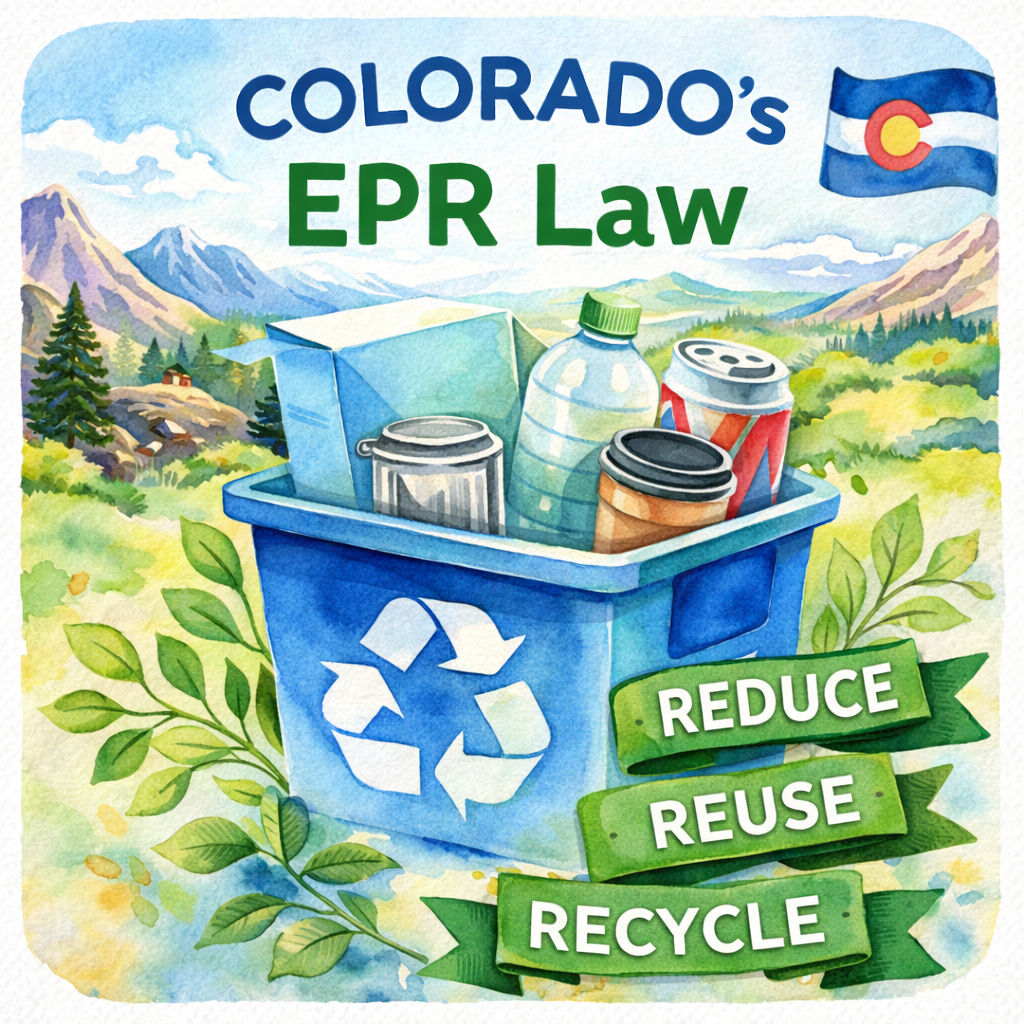
Now in active implementation, Colorado’s law, formally known as HB22-1355, establishes a statewide producer responsibility (EPR) program for recycling.
As of January 1, 2026, Colorado’s Extended Producer Responsibility (EPR) law has officially moved from planning into active implementation. For companies that sell products in packaging or paper in Colorado, this marks a real shift, from preparing for compliance to operating under it.
Colorado’s law, formally known as HB22-1355, establishes a statewide producer responsibility program for recycling. While the concept of EPR isn’t new, Colorado’s approach is one of the most comprehensive in the country, and it’s already beginning to change how recycling is funded, managed, and expanded across the state.
What Is HB22-1355?
HB22-1355, the Producer Responsibility Program for Statewide Recycling Act, was signed into law in 2022 and approved for implementation by the Colorado Department of Public Health and Environment (CDPHE) in late 2025. As of January 2026, the program is now fully “live.”
At its core, the law shifts the financial responsibility for recycling packaging and paper away from municipalities and taxpayers and onto the producers that place those materials into the Colorado market.
Who Is Running the Program?
Colorado appointed Circular Action Alliance (CAA) as the state’s Producer Responsibility Organization (PRO).
CAA is responsible for:
Registering obligated producers
Collecting annual producer dues
Managing recycling funds
Reimbursing municipalities
Expanding recycling access statewide
Any company selling packaged products or paper into Colorado must be registered with CAA to legally continue selling in the state.
CAA Resources
Website: https://circularactionalliance.org/
General inquiries: info@CircularActionAlliance.org
What changed on January 1, 2026?
Several major program elements became active at the start of the year:
1. Producer Registration & Dues
All obligated producers were required to register with CAA, and mandatory annual responsibility dues began on January 1, 2026.
These dues are eco-modulated, meaning:
Materials that are harder or more expensive to recycle (for example, polystyrene) carry higher fees
Materials with strong recycling markets (such as glass or certain paper grades) generally carry lower fees
This structure is designed to encourage better packaging design over time—not just fund recycling.
2. Expansion of Recycling Services
Colorado’s EPR program is designed to roll out over roughly five years. By 2030, the goal is to provide free, convenient curbside recycling to approximately 700,000 additional households across the state.
For residents who currently pay private haulers specifically for recycling services, those charges are expected to be eliminated as EPR-funded systems come online.
3. Municipal Reimbursements
Starting in 2026, local governments and municipalities that already operate recycling programs will begin receiving reimbursements for eligible recycling costs from the PRO-managed fund.
This is a major shift for cities that have historically absorbed these costs into strained municipal budgets.
4. State Oversight
The Colorado Department of Public Health and Environment (CDPHE) approved the final program plan in December 2025 and continues to oversee implementation.
CAA is required to submit its first administrative dues payment to CDPHE by June 30, 2026, reinforcing the state’s ongoing regulatory role.
What Does This Mean for Producers?
For producers, the Colorado EPR program introduces both financial and operational considerations:
Annual fees are now a real, recurring cost of doing business in Colorado
Packaging material choices directly affect fee exposure
Reporting accuracy matters more than ever
Multi-state EPR compliance is becoming the norm, not the exception
Many companies are discovering that EPR isn’t just an environmental issue; it’s also a data, forecasting, and design challenge.
How Portco Packaging Is Helping
At Portco Packaging, we work closely with brands navigating these new EPR requirements across multiple states. Currently, we’re actively developing tools and resources to help companies estimate potential EPR fee liabilities, including those under Colorado’s program.
Our focus is on helping teams understand how material choices may affect fees
We’ll be sharing more on these tools soon, including updates specific to Colorado and other active EPR states.
Want to Learn More?
If you’re unsure whether your business is obligated under Colorado’s EPR law or which specific materials are covered, now is the right time to dig in. The program is live, fees are active, and the landscape will continue to evolve.
If you’d like help understanding what this means for your packaging or how to prepare for what’s coming next, keep an eye out for upcoming updates from Portco Packaging.
♻️ Want to learn more about flexographic printing options? Reach out to use here and let’s have a conversation!
